Beyond the Degree: How AI Certifications are Becoming the New Tech Gatekeeper
Tech professionals scan job boards and notice a trend: AI professional courses appear in role requirements more frequently every month.
These certificates, once optional, now shape a candidate’s odds for interviews and salaries in both startup and legacy companies.
The landscape is shifting as organizations seek proof of specialized knowledge.
AI professional courses and certifications validate that a candidate understands not just algorithms, but how to build, tune, and scale models—a must-have in digital transformation projects.
Keep reading for specifics on how AI professional courses change hiring, what leading certifications cover, hands-on ways to prepare, and the future skills you’ll need to thrive in a workforce shaped by AI.
AI certificates redefine tech career paths with strategic skill sets

AI professional courses signal an applicant’s up-to-date skill set. Candidates see direct outcomes as shifting requirements put certified professionals at the top of the pile.
More companies now set minimum standards for machine learning proficiency using AI certifications. This allows recruiters to filter quickly, saving both time and energy during talent searches.
Credential stacking connects directly to project roles
When employees display multiple AI professional courses on their resumes, managers can deploy them to roles involving natural language tools, computer vision, or automation.
Unlike generic degrees, AI certifications map to practical tasks—such as deploying a chatbot to customer service or automating image tagging for media teams.
HR departments use certification titles as shortcuts to validate an applicant’s fit for pressing projects. The process creates a shared language among hiring managers in different departments.
Emerging standards foster trust and operational clarity
AI professional courses operate like a signals system in the tech industry. Each certification body defines what graduates can do through real code, project deliverables, or case studies visible on completion.
This transparency increases trust at every level—engineers know what a new hire is trained for, while leaders reduce onboarding risk because of recognized standards.
Operationally, this makes it easier to assign projects to staff who have completed specific AI professional courses for each toolset in use.
| Certification Name | Level | Skill Focus | Next Step |
|---|---|---|---|
| TensorFlow Developer | Intermediate | Model Building | Apply for ML developer roles |
| AI Ethics Certification | Entry | Responsible AI | Lead governance projects |
| Deep Learning Specialization | Advanced | Neural Networks | Research or dev roles |
| AI for Business Leaders | Managerial | Strategy and ROI | Lead digital adoption |
| Microsoft AI Engineer Associate | Associate | Deployment | Integrate models in cloud |
Evaluating the range of AI certifications gives applicants tangible actions
Sorting through the buzzwords, applicants discover that AI professional courses range in depth, duration, and employer recognition. Picking the right one can set you apart in a saturated market.
To make an informed choice, it helps to know which certifications prove hands-on knowledge, which signal theoretical grounding, and how your learning style matches each option’s format.
Reading between marketing lines identifies practical programs

Course descriptions sometimes hide details. Instead of relying only on titles, applicants dig into curriculum syllabi. They look for project-based assessments, coding challenges, or scenario-driven exams in high-quality AI professional courses.
- Compare real project requirements with job listings—choose AI professional courses with similar deliverables for direct skill translation.
- Choose certifications that require a portfolio submission, as these show practical capability to future employers without caveat.
- Confirm the recency of curriculum updates, since leading courses refresh content with each tech breakthrough.
- Match the course’s main stack (Python, R, cloud platforms) to the most prevalent tools used by current or target employers.
- Look for programs offering mentorship or community; ongoing peer support pays off post-certification.
Smart candidates cross-reference program websites with alumni LinkedIn results to verify outcomes and see real-world career movement following completion.
Understanding employer expectations helps target the right credentials
Recruiters now spot AI professional courses like TensorFlow Developer or AWS Certified Machine Learning on applicant resumes as positive differentiators for data science positions.
- Search recent job postings for required or preferred certifications in your specialty—and focus your training time accordingly.
- Reach out to hiring managers through informational interviews. Ask which AI professional courses most impressed them during past interviews.
- Note that global companies may prioritize standardized certifications, while local firms could prefer vendor-specific training closely tied to their stack.
- Document each credential on your resume under “Technical Certifications” for clarity, listing the skills applied during hands-on modules.
- Update your skills on professional profiles, and use badge features on LinkedIn to increase visibility in both recruiter searches and peer networks.
Proactive choices here put you on a direct, measurable path to new tech career possibilities and greater job mobility.
Course formats and learning environments impact skill retention quickly
Choosing between in-person, hybrid, and fully online AI professional courses gives learners control over how and when they tackle new material.
Students calculate commute costs, peer interaction levels, and mentorship accessibility before enrollment, seeking the best alignment with their daily routine and professional goals.
Online-only options support on-the-job upskilling, without relocation
Busy engineers, analysts, and managers frequently opt for recorded lectures, live coding demos, and forums built into top AI professional courses online. They can revisit tricky modules at their pace without missing work deadlines.
Course flexibilities—such as self-paced tracks or deadline extensions—reduce learner dropoff, especially for professionals juggling current projects alongside new study commitments.
Instructors for these courses tend to offer frequent feedback on code samples and solutions, allowing mid-course troubleshooting and confidence building before formal evaluation.
Group sessions and bootcamps accelerate project-based mastery
Bootcamp cohorts combine short, intensive sprints with collaborative projects—giving professionals a condensed taste of real-world AI systems development and debugging.
Face-to-face brainstorming and pair programming build rapport while accelerating troubleshooting skills in fast-paced technical environments.
Graduates report increased confidence applying AI professional course content to workflow automation projects immediately after finishing such immersive programs.
Certification exam preparation brings measurable improvements
Preparing for an AI certification requires more than theoretical note-taking; hands-on repetition and review of real-world case studies lead to measurable performance improvements.
Not all AI professional courses teach to the test—so supplementing official content with curated problem sets and group study helps applicants fill blind spots.
Practice exams and review questions mimic real certification challenges
Successful candidates schedule weekly practice exam blocks, treating them like timed, high-stakes job interviews. This exposes knowledge gaps and normalizes fast recall under pressure.
Reviewing failed attempts, especially questions on model optimization or deployment pitfalls, tightens candidate readiness for surprise scenarios on test day.
Collaboration in study groups, either through Slack or private forums, speeds learning when colleagues contribute sample scenarios drawn from their own roles or past AI professional courses.
Peer support networks sustain momentum through plateaus
Peers push each other to clarify tricky concepts, such as gradient descent or biased data sampling, with analogies grounded in familiar work problems.
Timing weekly check-ins keeps momentum high, while group accountability makes it less tempting to procrastinate on optional modules or challenging prep assignments.
Ongoing alumni involvement—when recent graduates coach those currently enrolled—injects practical advice directly from others who just finished similar AI professional courses and exams.
Upsides and trade-offs of certification-driven hiring practices stand out
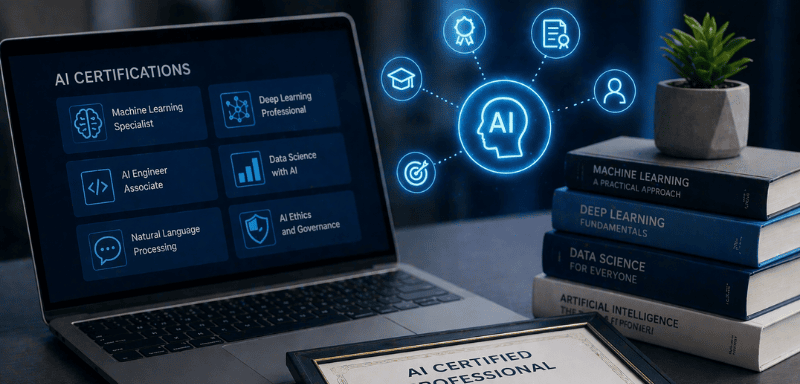
For job seekers, AI professional courses unlock new career directions and signal a commitment to staying relevant as technology shifts.
Yet, certification-driven hiring may narrow candidate diversity if skills acquired outside formal classes go unnoticed or underappreciated by recruiters scanning resumes quickly.
Mechanisms for broadening access beyond degree holders emerge
Employers increasingly recognize self-taught professionals who couple GitHub portfolios and completed AI professional courses as valuable additions to their teams.
Some hiring managers waive degree prerequisites entirely when advanced certifications or “nano-degree” achievement is clear and project portfolios demonstrate problem-solving.
Technologists from nontraditional backgrounds leverage bootcamps, community-driven programs, and scholarship-backed AI professional courses to reset or boost long-term earning potential.
Strategically sequencing learning pathways optimizes return on time
Veteran professionals weigh options carefully before selecting advanced AI professional courses, sequencing credentials by employer demand, role ambition, and gaps in current coursework.
For example, a data analyst might pursue a Python-focused certificate before advancing to cloud deployment coursework—deliberate planning for long-term advancement.
Conversely, those aiming for managerial or product roles may emphasize AI professional courses relating to ethics, compliance, or algorithmic transparency before diving into neural network specifics.
Signals from AI professional courses accelerate organizational transformation
Companies use new certification signals to prioritize internal upskilling and digital transformation investments. Team leads post openings for roles aligned to specific AI professional courses, making career pivots inside organizations more transparent and merit-based.
At the same time, talent development units analyze which AI professional courses drive measurable business results—like faster model release cycles or lower error rates in predictive analytics pipelines.
Learning incentives and internal badges create company-wide motivation
Employees pursue AI professional courses with company sponsorship to earn digital badges, bonus payouts, or public recognition during quarterly town halls.
Custom badge systems help staff visualize the skills available across teams and encourage peer learning as knowledge cascades from certification holders to new recruits.
Team members use these internal indicators to pitch themselves for AI pilot projects, mentoring others on applying lessons from specific AI professional courses.
Integrating AI certificates into hiring and promotion builds trust
HR teams formally recognize employees completing AI professional courses through promotion or lateral movement opportunities—sometimes adjusting compensation policies to reflect new credentials.
Managers use these certifications to vet candidates from internal transfer programs, ensuring talent redeployment is based on measurable capability, not seniority alone.
The result: clear trust between staff and leadership regarding who is ready for hands-on machine learning, automation, or AI governance work.
AI professional courses shape future-proof career moves
Throughout this article, we’ve walked through the reasons AI professional courses now matter at nearly every stage of a tech career, bridging skill gaps quickly and transparently.
As the labor market evolves, certifications no longer sit as resume afterthoughts—they form the spine of advancement strategies and enable professionals to demonstrate capabilities to both peers and leadership.
For anyone aiming to build a durable role in the next wave of technical innovation, investing in up-to-date, trusted AI professional courses remains a practical, measurable way to contribute and keep growing—wherever work takes you next.
Trending Topics

How to Follow Up After an Interview for Best Results
Don’t just wait — follow up the right way. This guide shows how to stay polite, show interest, and keep your name on the shortlist.
Keep Reading
Working in Fast Food Industry: Tips for Success and Growth
Learn how to start working in fast food in South Africa. No experience needed—just a good attitude and this step-by-step beginner's guide.
Keep Reading
Starbucks Jobs: Career growth, Benefits + up to $24/h
See how Starbucks shapes responsibilities, team dynamics and growth possibilities through structured training and stable routines.
Keep ReadingYou may also like

Eskom careers in 2025: what to know before you apply
Explore Eskom careers in plain terms: plant ops, grid planning, and IT/OT. Learn pay ranges, benefits, interview prep, and more.
Keep Reading
TELUS Digital: Remote Jobs in SA with No Experience Needed
Dreaming of working from home but don’t know where to start? TELUS Digital welcomes beginners! Discover how to land your first remote job.
Keep Reading
How coding assistants are changing software development jobs
Explore the shift in developer skills as AI takes over boilerplate code, making security, logic, and design the new primary focus.
Keep Reading
